What happened
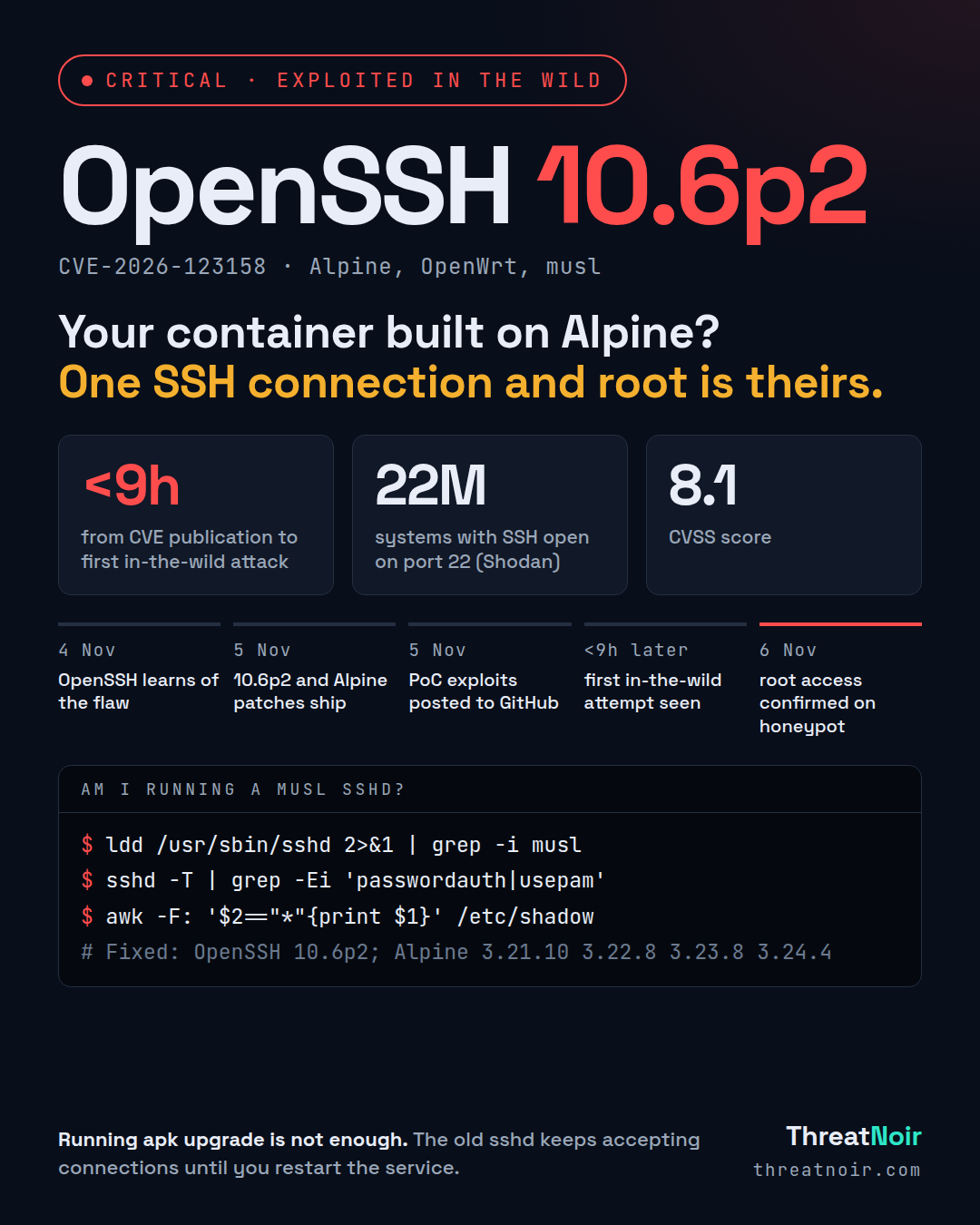
OpenSSH shipped an emergency fix on 5 November for an authentication bypass nicknamed SSHole, tracked as CVE-2026-123158 (CVSS 8.1). On musl-based Linux systems, such as Alpine, with PAM disabled and password login on, an attacker can log into an account that has no password by sending a password between 257 and 1,024 characters.
The root cause goes back to 2016. To close a username enumeration flaw (CVE-2016-6210), sshd was changed to hash a password even when an account has no usable hash, borrowing another account's salt. Since 2012, musl's crypt() rejects SHA-256 and SHA-512 passwords longer than 256 bytes and returns "" on failure. Accounts configured for key-only or no login carry "" in /etc/shadow. The "" error value matches the stored "", and sshd lets the attacker in.
The flaw does not bypass passwords on accounts that have a real hash. OpenSSH developer Damien Miller says the bug is not in sshd itself but can be triggered through it. The 10.6p2 release blocks the path.
Timeline
- 4 Nov: OpenSSH is told about the flaw.
- 5 Nov: OpenSSH 10.6p2 ships; Alpine pushes patched packages for every branch from 3.16 to edge.
- 5 Nov: Proof-of-concept exploits appear on GitHub (unverified, may contain malware).
- Less than 9 hours after CVE publication: Previdian's sensors see the first attempt.
- 6 Nov: Previdian confirms successful root access on an Alpine honeypot. Eight attempts seen so far, all from a single Japan-based address, 89.116.89[.]18, running id, uname and hostname.
CISA has not yet added it to KEV. Previdian has added it to its own known-exploited list.
Am I affected?
You are at risk if all of these hold:
- OpenSSH runs on a musl-based system: Alpine, OpenWrt, Buildroot, Yocto, or many Docker images.
- PAM is disabled (the default for Alpine's openssh-server package, or openssh-server-pam with UsePAM no).
- SSH password authentication is enabled (the OpenSSH default).
- At least one account has "*" in its password field (root since about Alpine 3.16, key-only users made with adduser and no password, the default alpine user in cloud images, or musl-nscd directory users).
- At least one other local account has a $5$ or $6$ password hash.
Alpine's official AWS and Azure tiny-cloud images (3.18.11 through 3.24.3) ship a default alpine account with "*" and passwordless doas, so a login there is effectively root.
Not affected: glibc systems (Debian, Ubuntu, Fedora), PAM-enabled setups (UsePAM yes), Dropbear, OpenBSD, and containers that do not run sshd.
What to do now
- Update OpenSSH. On Alpine: apk upgrade openssh. Fixed releases include 3.21.10, 3.22.8, 3.23.8 and 3.24.4. A lower version number may still be patched.
- Restart sshd. Updating alone leaves the old daemon running and still vulnerable. Keep an existing session open while you do this.
- If you cannot patch yet, set PasswordAuthentication no in sshd_config, confirm key-based access works, and restart sshd.
- Block or watch the known source IP 89.116.89[.]18.
How to hunt
Look for password logins to accounts that should not accept one:
grep "Accepted password" /var/log/messages- If the alpine, root or a key-only user appears, check the shadow field:
grep '^alpine:' /etc/shadow. A "*" there plus a successful password login is a strong sign of exploitation. - Review doas use, recently created users and authorized_keys files.
If you cannot rule out a login, treat the machine as compromised.
What does not help
- Running apk upgrade without restarting sshd. The running daemon keeps accepting connections.
- Relying on PermitRootLogin to protect you. The larger risk is indirect root through accounts like the default alpine user with passwordless doas.
- Downloading the GitHub PoCs. Previdian warns they are unverified and may contain malware.
Sources
- OpenSSH Rushes Patches for ‘SSHole’ Authentication Bypass, SecurityWeek, 6 Nov
- OpenSSH flaw exploited in the wild just hours after disclosure (CVE-2026-123158), Help Net Security, 6 Nov
- OpenSSH Flaw Could Let Attackers Bypass Password Authentication on Alpine Linux Servers, Cyber Security News, 5 Nov
- OpenSSH flaw lets attackers log into password-disabled Linux accounts, BleepingComputer, 5 Nov
- OpenSSH Issues Emergency Fix for Flaw Letting Long Passwords Bypass SSH Auth on Alpine Linux, The Hacker News, 5 Nov